


What Does “America First” Actually Mean?
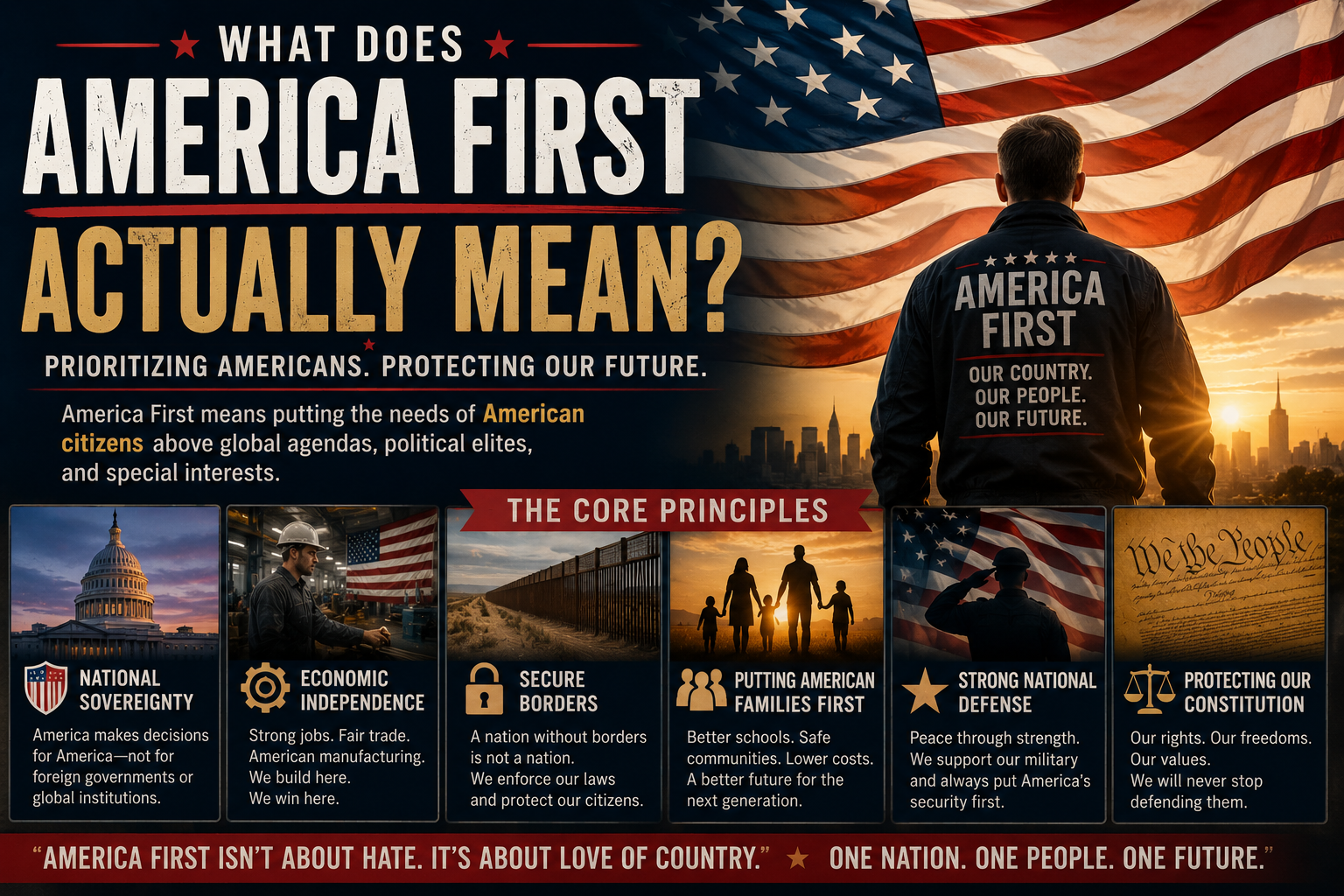
Few political phrases in recent American history have generated as much attention, debate, and emotion as “America First.” Supporters view it as a call to restore national sovereignty, strengthen the middle class, secure borders, and prioritize American citizens in economic and foreign policy decisions. Critics often argue the phrase represents nationalism, isolationism, or a retreat from international leadership.
But beyond political slogans and campaign rhetoric, the phrase reflects deeper questions about national identity, globalization, economic priorities, and the role of government itself.
At its core, “America First” is built around the idea that American leaders should prioritize the interests of American citizens when making decisions involving trade, immigration, foreign policy, energy, manufacturing, and economic strategy.
Supporters argue this should not be controversial.
Every nation, they argue, naturally seeks to protect its own economic stability, security, and cultural identity. In this view, America First policies are less about hostility toward other countries and more about re-centering government priorities around the needs of the American people.
The phrase gained renewed prominence during a period of growing frustration among working-class and middle-class Americans who felt left behind by globalization. For decades, factories closed across industrial regions as manufacturing moved overseas in search of lower labor costs. Entire communities experienced economic decline, job loss, and social instability.
Many Americans began feeling disconnected from political and corporate elites who appeared insulated from these economic consequences.
Trade policy became one of the movement’s defining issues.
Supporters of America First economic policies often advocate for:
- domestic manufacturing,
- fair trade agreements,
- energy independence,
- stronger supply chains,
- and reduced dependence on foreign competitors.
The COVID-19 pandemic reinforced many of these concerns when supply chain disruptions exposed America’s reliance on overseas production for critical goods and medical supplies.
Immigration is another central issue.
Advocates of America First policies typically support stronger border enforcement and immigration systems focused on national security, legal processes, and economic sustainability. They argue uncontrolled immigration can strain housing, healthcare, education systems, and public resources while weakening confidence in the rule of law.
Others disagree strongly, arguing immigration has historically strengthened America economically and culturally. This debate remains one of the most emotionally charged subjects in American politics.
Foreign policy is also deeply connected to America First philosophy.
Supporters often favor reducing prolonged foreign military involvement and focusing greater attention on domestic priorities such as infrastructure, economic growth, and national security at home. Critics argue strong international alliances and global leadership remain essential to maintaining stability and protecting American interests abroad.
The debate reflects a broader question:
What should America’s role in the world be?
For many Americans, the phrase “America First” also represents cultural frustration. Some supporters believe traditional values, patriotism, religious freedom, and constitutional principles have been weakened by political polarization, institutional distrust, and rapid cultural change.
This helps explain why the movement resonates emotionally with many voters.
The phrase is not only economic or political — it is cultural and symbolic as well.
Technology and media have accelerated the movement’s growth. Independent podcasts, livestreams, social media creators, and alternative news platforms helped build communities outside traditional political institutions. Many supporters felt legacy media outlets dismissed or misrepresented their concerns, leading them toward independent digital ecosystems.
This shift transformed political communication.
Movements no longer rely entirely on television networks or newspapers to reach voters. Digital platforms allow ideas, videos, commentary, and grassroots organizing to spread rapidly through online communities.
Critics of the America First movement often warn that aggressive nationalism can deepen division, reduce international cooperation, or inflame political tensions. Supporters counter that prioritizing citizens and national interests is simply responsible governance.
The phrase means different things to different people.
For some, it means:
- economic nationalism,
- border security,
- constitutional rights,
- and energy independence.
For others, it symbolizes:
- populism,
- resistance to global institutions,
- distrust of political elites,
- and cultural preservation.
What is undeniable is the movement’s influence on modern politics.
America First themes now shape debates involving:
- trade,
- immigration,
- media,
- education,
- foreign policy,
- manufacturing,
- and national identity.
The phrase has become larger than any individual politician or election cycle because it reflects broader anxieties and frustrations shared by millions of Americans.
Ultimately, the debate surrounding America First raises fundamental questions about the country’s future direction:
- What responsibilities should government prioritize?
- How should America compete globally?
- What defines national identity?
- And how should leaders balance international obligations with domestic needs?
Those questions are unlikely to disappear anytime soon.
Join MAGABOOK Today! https://MAGABOOK.com
 Turkish
 English
 Arabic
 French
 Spanish
 Portuguese
 Deutsch
 Dutch
Dutch
 Italiano
 Russian
 Romaian
 Portuguese (Brazil)
 Greek
Greek