Few issues in modern America have generated more controversy than the growing debate over free speech in the digital age. Technology platforms now shape how billions of people communicate, consume news, organize politically, and express opinions online. Companies that began as social networking tools have evolved into some of the most powerful gatekeepers of information in human history.
With that power has come growing concern.
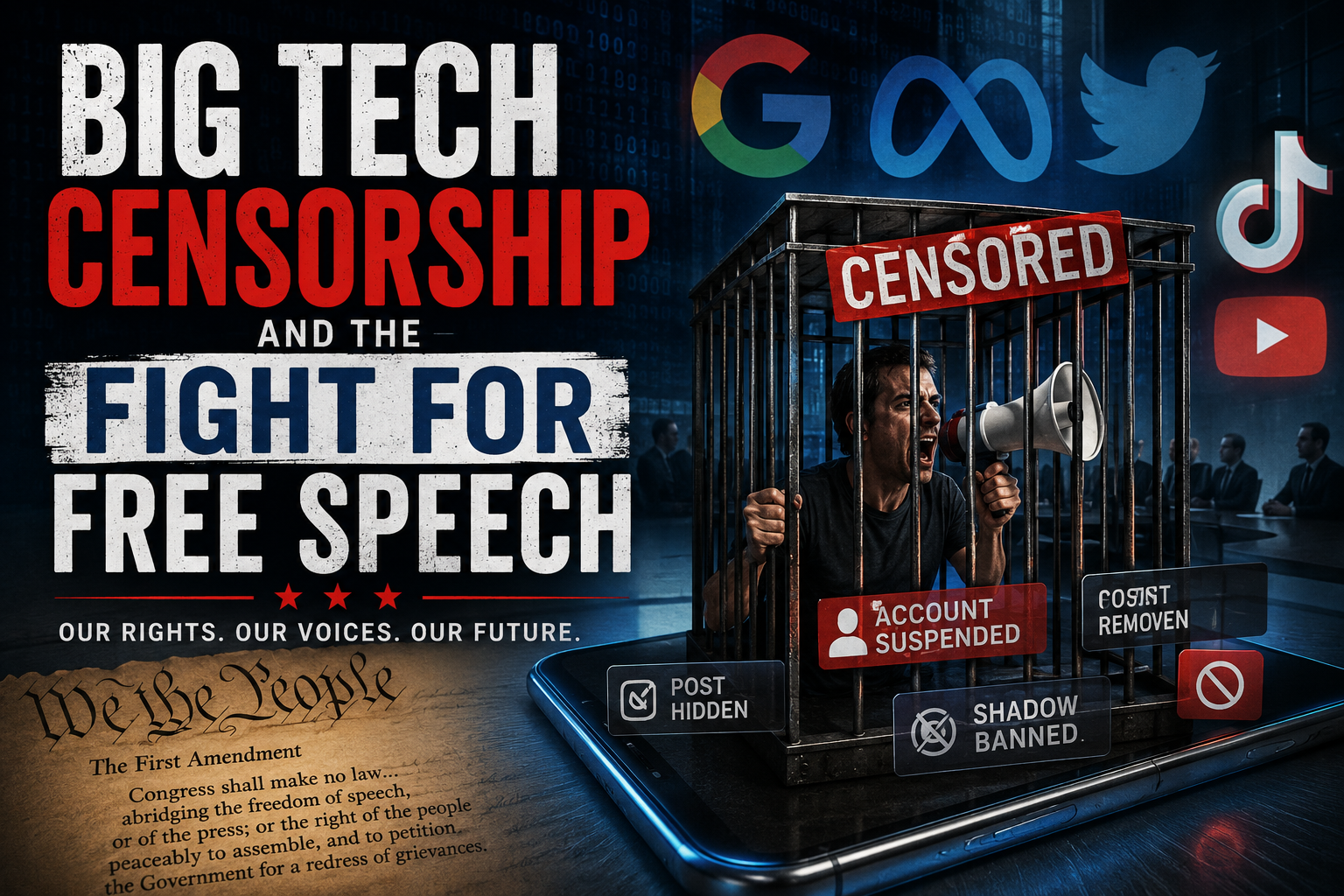
Millions of Americans increasingly believe large technology corporations exercise enormous influence over public discourse through content moderation policies, algorithmic visibility controls, account suspensions, and platform censorship. Supporters of stricter moderation argue these measures are necessary to combat misinformation, harassment, violence, and harmful content. Critics argue such policies often suppress political viewpoints, silence dissent, and threaten open democratic debate.
The conflict sits at the center of modern political and cultural life.
Historically, free speech debates focused largely on government censorship. The First Amendment protects Americans from government restrictions on speech and expression. But the rise of massive digital platforms created a new challenge: what happens when private corporations control the modern public square?
Today, platforms influence nearly every aspect of public conversation.
News spreads through social media feeds.
Political campaigns organize online.
Movements gain momentum digitally.
Businesses market through algorithms.
Journalists rely on platform distribution.
Creators depend on audience reach.
This concentration of influence has raised difficult questions about fairness, transparency, and accountability.
Critics of Big Tech censorship argue that moderation systems are often inconsistent and politically biased. They point to cases where accounts were suspended, videos removed, or topics suppressed during politically sensitive moments. Many conservatives believe right-leaning viewpoints receive harsher scrutiny than progressive perspectives.
High-profile suspensions involving politicians, commentators, doctors, journalists, and activists intensified these concerns. Regardless of whether individual moderation decisions were justified, millions of Americans became alarmed by the sheer power technology companies hold over public communication.
Algorithms also play a major role.
Modern social media platforms do not simply display information neutrally. Algorithms determine what content users see, how often they see it, and which topics trend publicly. Critics argue this invisible control over information flow allows corporations to shape public perception in subtle but powerful ways.
Even small algorithm changes can dramatically affect political reach, media visibility, and public influence.
The COVID-19 era intensified the censorship debate significantly. Platforms removed or restricted content related to public health, vaccines, lockdowns, and pandemic policies. Supporters argued extraordinary circumstances required aggressive moderation to combat dangerous misinformation. Opponents argued legitimate debate and scientific disagreement were being suppressed too aggressively.
This period caused many Americans to rethink how much power private corporations should hold over public conversation.
Trust in technology companies declined further as internal communications, leaked documents, and congressional hearings revealed the enormous behind-the-scenes influence platforms exercise over digital speech. Americans increasingly questioned whether unelected corporate executives should possess the authority to determine acceptable political discourse for hundreds of millions of users.
At the same time, the internet remains filled with real challenges.
Platforms must address:
- scams,
- criminal activity,
- explicit threats,
- violent extremism,
- spam,
- harassment,
- and coordinated manipulation campaigns.
The challenge lies in balancing platform safety with free expression.
Supporters of stronger speech protections argue that open societies require robust debate, even when discussions become controversial or uncomfortable. They warn that censorship powers created for one political moment can eventually be used against many different groups over time.
Technology has fundamentally changed the meaning of speech itself.
In previous generations, public communication required access to television networks, newspapers, or radio stations. Today, individuals can reach millions of people directly through videos, livestreams, podcasts, blogs, and social media platforms. This democratization of communication created enormous opportunity but also intensified conflict over who controls digital space.
Alternative platforms emerged partly in response to these concerns.
Many users began seeking:
- free speech-focused platforms,
- independent video hosting,
- decentralized social networks,
- private communities,
- and creator-controlled ecosystems.
Independent media creators also exploded in popularity because audiences increasingly wanted direct access to information outside traditional institutional filters.
The debate over digital censorship extends far beyond politics.
Questions surrounding free speech affect:
- religion,
- science,
- medicine,
- comedy,
- education,
- journalism,
- activism,
- and cultural identity.
Nearly every institution now operates within a digital environment shaped by technology platforms.
The future of online speech may become one of the defining issues of the 21st century.
Governments worldwide are considering new regulations surrounding platform moderation, data privacy, misinformation, and digital rights. Some argue stronger oversight is necessary to prevent corporate overreach. Others warn government involvement could create even greater threats to free expression.
Meanwhile, public demand for transparency continues growing.
Americans increasingly want to know:
- how moderation decisions are made,
- how algorithms function,
- who influences platform policy,
- and whether all viewpoints receive equal treatment.
The conversation surrounding Big Tech censorship ultimately reflects a broader struggle over power, information, and freedom in the digital age.
Who controls public discourse?
Who decides acceptable speech?
How much authority should corporations possess?
And can truly open conversation survive in an era dominated by powerful digital platforms?
These questions are reshaping politics, media, and society in real time — and the answers may determine the future of free expression in America for generations to come.

 Spanish
 English
 Arabic
 French
 Portuguese
 Deutsch
 Turkish
 Dutch
Dutch
 Italiano
 Russian
 Romaian
 Portuguese (Brazil)
 Greek
Greek