

 Find Candidates
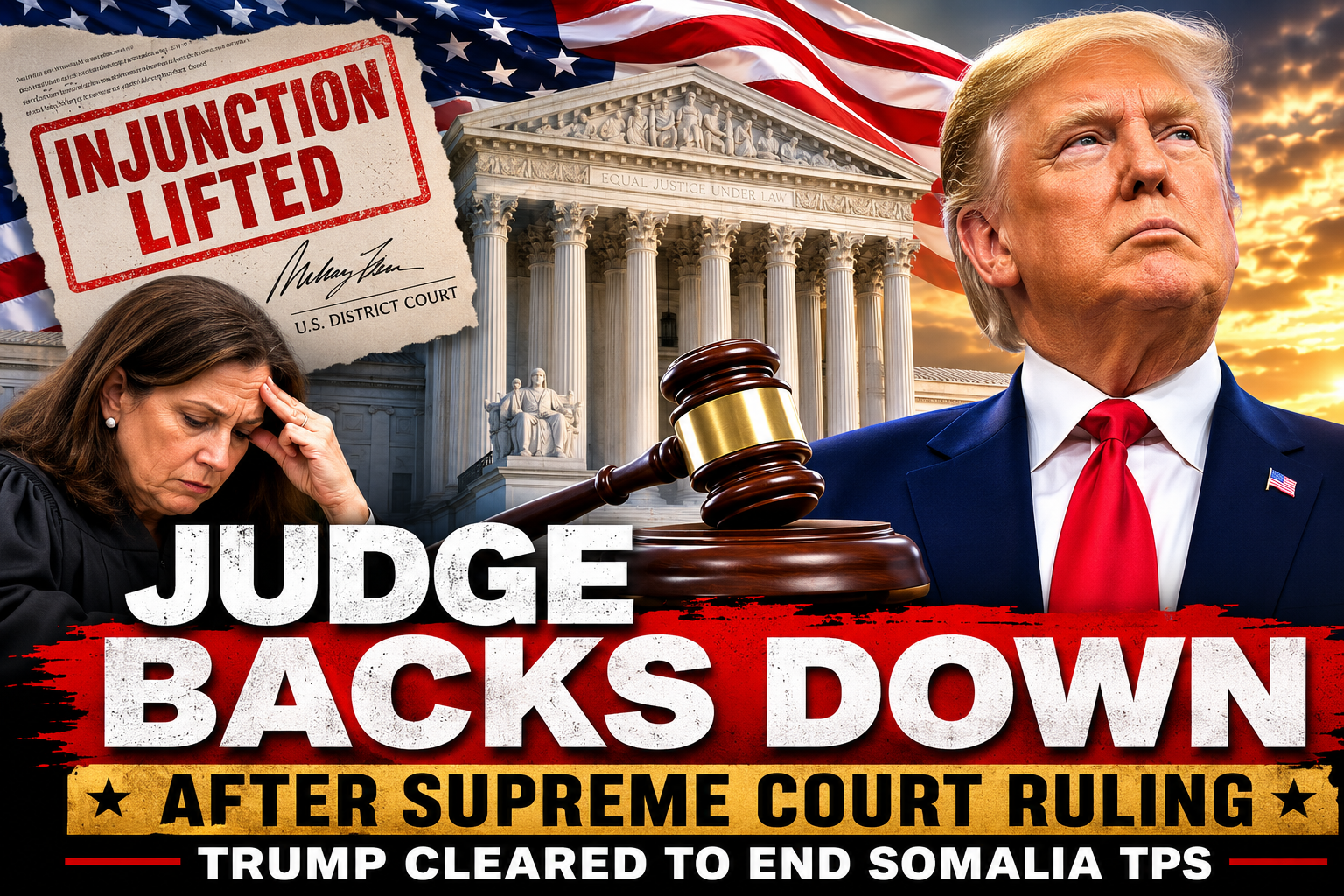
Judge Backs Down After Supreme Court Ruling
An Obama-appointed federal judge who repeatedly blocked the Trump administration from ending Temporary Protected Status for Somali nationals has now lifted her own stay after a Supreme Court ruling sharply restricted lower-court review of the executive branch's TPS decisions.
The development is about immigration, but the larger story reaches far beyond Somalia.
It is the latest chapter in a continuing battle over the authority of federal district judges to stop policies adopted by an elected president — and what happens when the Supreme Court tells lower courts that Congress has placed certain executive decisions largely beyond their review.
U.S. District Judge Allison Burroughs of Massachusetts lifted her stay Friday, clearing the way for President Donald Trump's administration to proceed with terminating Somalia's Temporary Protected Status designation.
Burroughs, who was appointed by former President Barack Obama, had previously prevented the Department of Homeland Security from implementing the termination.
But a major Supreme Court decision in June changed the legal landscape.
After 35 years, Somalia’s TPS is TERMINATED!
— Brigitte Gabriel (@ACTBrigitte) August 15, 2026
81% of Somali immigrant households in Minnesota are WELFARE. A drain on American taxpayers.
Time to return home and Make Somalia Great Again pic.twitter.com/efXpfthUQF
Burroughs ultimately acknowledged that she was constrained by the Supreme Court's ruling.
The Judge Who Blocked Trump Lifts Her Own Stay
This is the part of the story that deserves particular attention.
Burroughs wasn't simply reviewing another judge's order.
She was lifting her own stay.
Earlier this year, the Trump administration moved to terminate Somalia's TPS designation, which had provided eligible Somali nationals with temporary protection from removal and authorization to work in the United States.
Four Somali nationals and advocacy organizations, including African Communities Together, sued to stop the administration.
Burroughs intervened and prevented the termination from taking effect while the lawsuit proceeded.
The plaintiffs argued that the administration's action was improperly motivated by racial and national-origin discrimination, pointing in part to statements Trump had previously made about Somalia and Somali immigrants.
The administration disputed those allegations and maintained that the Department of Homeland Security possessed the authority to determine whether a country's TPS designation should continue.
Then the Supreme Court weighed in on closely related TPS disputes.
The Supreme Court Changed the Legal Landscape
On June 25, the Supreme Court issued its decision in Mullin v. Doe, consolidated with Trump v. Miot.
The cases concerned Trump administration decisions ending TPS designations for Syria and Haiti.
By a 6-3 vote, the Supreme Court reversed the lower courts.
The Court concluded that federal law generally bars judicial review of non-constitutional challenges to the Homeland Security secretary's decision to terminate a country's TPS designation.
The relevant statute is unusually direct.
Federal immigration law provides that there is no judicial review of certain determinations by the Homeland Security secretary concerning the designation, extension or termination of TPS.
That statutory restriction became central to the Supreme Court's ruling.
The Court also concluded that the equal-protection challenge presented in the Haitian case was unlikely to succeed.
That portion of the decision became especially important for the Somalia lawsuit because the Somali plaintiffs were advancing a similar argument alleging discriminatory motivation.
Once the Supreme Court ruled, the legal foundation supporting continued lower-court intervention became considerably narrower.
Burroughs: Bound by the Supreme Court
Even after the Supreme Court's ruling, the Somalia litigation continued.
The plaintiffs amended their lawsuit and pursued constitutional claims, arguing that terminating Somalia's designation violated the Fifth Amendment because the administration's decision was allegedly based on racial and national-origin discrimination.
Burroughs temporarily kept the administration from acting while considering those arguments.
But on August 14, she lifted the stay.
Her reasoning is significant.
Burroughs made clear that the Supreme Court's decision in Mullin controlled how she had to evaluate the plaintiffs' likelihood of success.
She wrote that she was "bound ... to view things through the Mullin prism."
That is an important acknowledgment.
Burroughs continued to express concern about what could happen to Somali TPS holders. She concluded that the plaintiffs had made a convincing showing that they could suffer irreparable harm and believed the balance of hardships favored them.
But those findings were not enough.
A party seeking an injunction must also demonstrate a sufficient likelihood of ultimately succeeding on its legal claims.
After the Supreme Court's decision, Burroughs concluded the plaintiffs could not clear that hurdle.
So the judge who had blocked the administration lifted her own stay.
A Larger Battle Over Lower Courts
The decision comes amid a much larger constitutional and political debate surrounding federal district courts during Trump's second administration.
Trump administration policies involving immigration and other areas have repeatedly encountered injunctions or temporary orders from individual federal judges.
Supporters of those rulings argue that judicial review is an essential constitutional safeguard and that federal courts must be able to stop unlawful executive actions.
Conservatives have increasingly raised the opposite concern: whether individual district judges are using temporary restraining orders, administrative stays and nationwide injunctions to exercise authority far beyond the traditional role of a trial court.
The Supreme Court has increasingly confronted questions surrounding the scope of lower-court remedies.
The Somalia TPS dispute adds another example to that broader conflict.
In this instance, Congress itself had enacted statutory language limiting judicial review of TPS determinations.
And once the Supreme Court interpreted that language, the lower court was required to operate within that precedent.
That is how America's judicial hierarchy is designed to work.
The Supreme Court Did Not Eliminate Judicial Review
There is an important distinction that should not be lost in the political debate.
The Supreme Court did not declare that presidents are immune from judicial review or that federal judges can never block executive actions.
Nor did the Court broadly prohibit all constitutional challenges to TPS decisions.
Its decision was more specific.
The Court held that the TPS statute bars judicial review of non-constitutional challenges to the Homeland Security secretary's TPS termination determinations.
It separately addressed the equal-protection argument presented in the Haiti litigation and concluded that the challengers were unlikely to succeed.
That distinction matters because accurately describing the Supreme Court's holding makes the implications of Burroughs' reversal more — not less — significant.
A lower court had blocked an executive action. The Supreme Court clarified the limits Congress placed on judicial review. The lower court then had to reconsider its intervention under that controlling precedent.
Somalia's "Temporary" Protection Began in 1991
Behind the court battle is another extraordinary fact.
Somalia's Temporary Protected Status designation dates back to 1991.
Congress created TPS in 1990 to provide humanitarian protection to eligible foreign nationals already in the United States when war, natural disaster or other extraordinary circumstances make returning to their home country unsafe.
Somalia was designated the following year as civil war devastated the country.
Successive administrations extended the protection again and again.
By 2026, a program explicitly described as temporary had existed for Somali nationals for approximately 35 years.
That longevity has become a central argument for immigration restriction advocates who contend that temporary humanitarian programs can evolve into effectively permanent immigration policies without Congress ever explicitly making them permanent.
The Supreme Court itself noted in Mullin that although TPS was designed to provide temporary relief, designations have in practice sometimes lasted for decades.
How Many Somali Nationals Are Actually Affected?
Reporting on the number of people affected has varied, making this an important fact to handle carefully.
Reuters reported that nearly 1,100 Somali nationals were receiving the protections at issue.
Other reporting, citing U.S. Citizenship and Immigration Services sources, has provided larger figures when including different categories of TPS holders and pending applicants.
The important distinction is that ending Somalia's TPS designation does not mean every Somali immigrant or Somali-American is subject to deportation.
TPS is a specific immigration classification.
Individuals may have another lawful basis to remain in the United States, and American citizens of Somali ancestry are obviously unaffected by the termination of TPS.
Those whose lawful protection depends solely on Somalia's TPS designation, however, could lose their protection from removal when the termination takes effect.
Opponents Say Somalia Remains Dangerous
Immigration advocates argue that the humanitarian reasons for protecting Somali nationals have not disappeared.
Somalia continues to struggle with political instability and terrorism, including violence involving the Islamist militant organization al-Shabaab.
Opponents of the Trump administration's decision argue that forcing longtime TPS beneficiaries to return could expose them to dangerous conditions.
Those humanitarian concerns helped persuade Burroughs that the plaintiffs could suffer irreparable harm.
But a judge's assessment of hardship does not by itself establish the legal authority to prevent an executive action.
After Mullin, that distinction became decisive.
Why Conservatives Are Watching This Case
For MAGA and America First voters, the significance extends beyond immigration policy.
The case goes directly to one of the defining institutional battles of Trump's second presidency:
Who has the constitutional and statutory authority to make policy, and what are the limits of a single federal district judge's power to stop it?
The Constitution gives Congress legislative authority.
Congress created the TPS program and expressly restricted judicial review of certain decisions under it.
The executive branch administers the program through the Department of Homeland Security.
The courts interpret the law and adjudicate legitimate constitutional disputes.
But lower federal courts are also bound by decisions of the Supreme Court.
That final point is what makes the Somalia decision particularly noteworthy.
Burroughs clearly remained sympathetic to arguments advanced by the plaintiffs.
Nevertheless, she concluded that Supreme Court precedent prevented her from continuing to provide the relief they sought.
Trump's Immigration Agenda Gains Another Victory
The ruling also gives the Trump administration another important victory in its broader effort to dismantle TPS designations it believes have outlived their temporary purpose.
The administration has pursued termination of protections involving several countries.
Those efforts have generated a complicated series of lawsuits, stays, appeals and Supreme Court proceedings.
But the June Mullin ruling substantially strengthened the executive branch's position.
The Supreme Court reversed lower-court intervention involving Haiti and Syria, and its reasoning has since affected other TPS litigation.
Somalia now joins that broader legal story.
The Underlying Lawsuit Is Not Over
The lifting of the stay should not be confused with a final judgment ending every aspect of the litigation.
The plaintiffs' underlying constitutional claims can continue through the courts.
What changed is the immediate ability of those plaintiffs to keep the Trump administration's Somalia TPS termination frozen while the case proceeds.
Unless another court intervenes, DHS can move forward with implementing the termination.
That distinction is important because headlines declaring that the entire lawsuit has been resolved would overstate what happened.
Trump won the immediate fight over whether his administration can proceed.
The broader litigation can continue.
The Bottom Line
The most consequential part of this story isn't simply that Somalia's 35-year-old TPS designation is being terminated.
It is how the administration got here.
A federal district judge blocked Trump's policy.
The Supreme Court subsequently issued a 6-3 ruling clarifying that Congress had sharply limited judicial review of TPS termination decisions and finding that the equal-protection challenge before it was unlikely to succeed.
The Somali plaintiffs attempted to continue their challenge on constitutional grounds.
Burroughs considered those arguments, acknowledged the hardships the plaintiffs could face, and nevertheless concluded that the Supreme Court's precedent constrained her.
She then lifted her own stay.
That makes this much more than another immigration story.
It is another chapter in the ongoing struggle over presidential authority, congressional statutes, judicial power and the constitutional boundaries separating America's branches of government.
And for an administration that has spent much of its second term fighting lower-court injunctions, the message from this case is unmistakable:
District courts get their say. But the Supreme Court gets the final word.
MAGABOOK will continue following the Trump administration, the Supreme Court, immigration policy and the court battles shaping America's government.
Connect. Share. Make a Difference.


 English
 Arabic
 French
 Spanish
 Portuguese
 Deutsch
 Turkish
 Dutch
Dutch
 Italiano
 Russian
 Romaian
 Greek
Greek